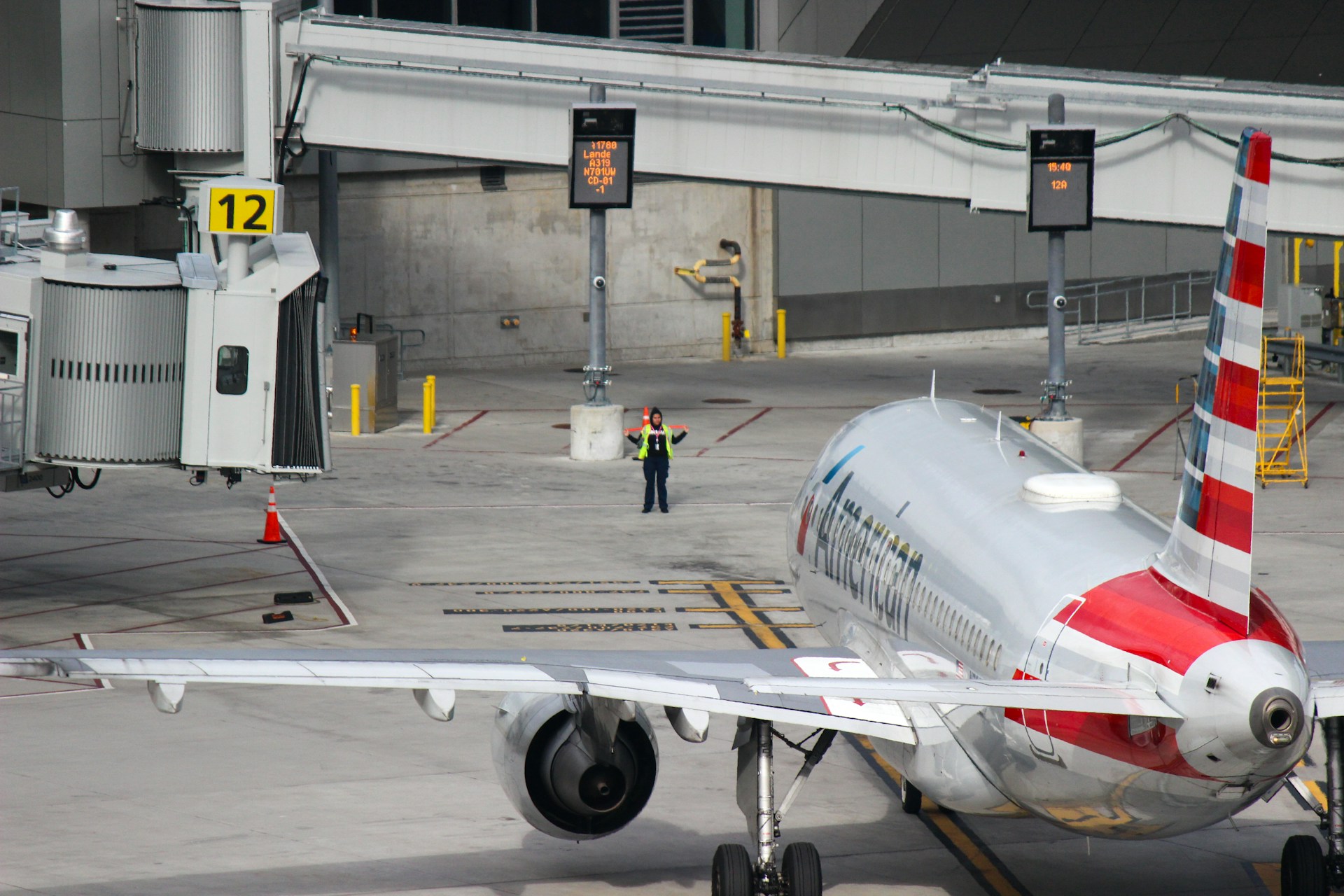
Ground handling takes place in one of the industry's most hostile sound environments. An A320 or B737 on idle already generates 70 to 80 dB; add to that the ground power units, tugs and jet blast, and the level regularly exceeds 100 dB. In this context, communication between the pilot, tug driver and ramp agents cannot rely on gestures or cables that restrict movement. The wireless communication headset has become a fully-fledged operational tool, at the crossroads of safety, hearing protection and productivity – every minute of delay in taxiing can be very costly for an airline.
To establish this ranking, our analysis was based on objective operational criteria: full-duplex capability (speaking and listening simultaneously, without a PTT button), certified noise reduction and passive attenuation, actual range on the apron, number of simultaneous users, battery life for a full rotation, robustness against bad weather, quality of integration with the aircraft intercom, and finally, the depth of deployment and support in Europe. Commercial ratings and «marketing» rankings were discarded in favour of these factual elements.
Seven solutions stand out in 2026. They include both European airport communication specialists and global brands widely distributed across the continent. At the top of our ranking, the GLOBALSYS Airlink 2085 excels with a rare balance between audio performance, ergonomics, and adoption by the largest handlers.
| Rank | Solution | Highlights | Origin |
|---|---|---|---|
| 1 | GLOBALSYS Airlink 2085 | Full-duplex 4 users, 300 m, −32 dB SNR, 12 h battery life hot-swap batteries, USB-C | France |
| 2 | CeoTronics CT-DECT / CT-GateCom | DECT full-duplex, up to 5 (12 with base), ambient sound reception (ASR), made in Germany | Germany |
| 3 | David Clark Series 9900 Wireless | Anti-icing/de-icing system, 1 or 3 station configuration, proven robustness | USA / Europe |
| 4 | Flightcom (Sonetics) | Integrated full-duplex in a noise-cancelling headset, ComCare service programme | United States of America |
| 5 | dBD Communications | Pushback + wing-walker, double liaison (cockpit / team), mic options depending on role | United Kingdom |
| 6 | Inbertec UW2000 | Full-duplex, UGA100 aircraft gateway, UGB100 walkie integration | International |
| 7 | 3M Peltor WS LiteCom | Hearing protection + built-in two-way radio, Bluetooth, level-dependent attenuation | Sweden / Europe |
At the head of this ranking, the GLOBALSYS Airlink 2085 est tout aussi bien placé pour s'imposer comme la solution la plus aboutie pour l'assistance en escale en 2026. Conçu et fabriqué par GLOBALSYS, spécialiste français de la Wireless communication for ground support Since 1997, this system has linked the cockpit and the ground crew via full-duplex communication: everyone can speak and listen at the same time, without the need for push-to-talk, which has radically improved the smooth running of pushback, de-icing and docking operations.
What sets this actor apart, first and foremost, is the coherence of its architecture.’Airlink 2085 This links an aircraft base station, a wireless headset, a beltpack, and a desktop unit to cover both the supervisor in the control room and mobile agents around the aircraft. The system accepts up to four simultaneous users in conference, with a full-duplex range of 300 metres and a wide audio band (200–7000 Hz) that preserves voice intelligibility where it matters: at the foot of the jet engines.
In terms of protection and endurance, the arguments are just as tangible. The headsets offer a noise reduction of -32 dB SNR, complemented by digital filtering, a 12-hour battery life, and «hot-swap» removable batteries that allow for continuous rotation without losing connection. USB-C charging for all components simplifies team logistics. The base connects to the aircraft's standard 6.35 mm intercom jack, without interfering with other ground crews or risking lightning transmitted through the airframe.
A justified positioning, finally, by widespread adoption: the Airlink range equips major airlines and service providers globally — American Airlines, British Airways, ANA, Qantas, Cathay, as well as handlers like Swissport, Menzies Aviation and dnata, and manufacturers such as Airbus and Dassault Aviation. Certified ISO 9001 and EN 9100, GLOBALSYS boasts over 25 years of expertise exclusively dedicated to wireless communication and hearing protection. It is this combination — audio performance, ergonomics designed for long shifts, and strong operational references — that places the Airlink 2085 at the top of our 2026 rankings.
📍 Rue Hélène Boucher, 2b Av. des Coquelicots, 94380 Bonneuil-sur-Marne 🔗 Official Website: global-sys.com ☎ 01 43 99 42 17
The German manufacturer CeoTronics holds a leading position in the European airport communications market. Its CT-DECT technology is based on an over-the-ear headset with an integrated DECT transceiver, capable of connecting up to five users in full-duplex mode, and up to twelve when paired with a CT-DECT Case base station. The advertised range is 300 metres, with no perceptible latency and no buttons to press.
What sets this actor apart is its obsession with bidirectional sound security. The ASR (Ambient Sound Reception) function allows you to hear warning signals and surrounding voices despite advanced acoustic insulation, while the CT-HN «HighNoise» headset is designed as a fully functional piece of PPE. The CT-GateCom II system connects to the aircraft's intercom to cover all assistance activities, from pushback to communication with the cockpit.
The market recognises this expertise: Frankfurt Airport (Fraport) has adopted the CT-DECT Multi for its runway operations and agent training. Manufactured in Germany, the system represents the most credible European alternative to French solutions in this segment.
Germany
Historic aviation brand, David Clark With the Series 9900 Wireless, the company offers a system designed specifically for pushback and de-icing operations, which is widely available across Europe through GSE supplier networks. Its promise: to free ground crews from the constraints of cables whilst maintaining the reliability for which the brand is renowned.
What sets this solution apart is its modularity for ground operations. The system can be configured as a single station – for a lone tractor driver – or as a three-station configuration, to connect the operator with the wing-walkers. The components (boarding bridge, interface cable to the aircraft service panel, noise-attenuating headsets, and belt stations) are designed to withstand heavy use on the apron.
A positioning that is primarily aimed at operators looking for hardened equipment and an already established international support network, even if it means putting up with more conventional ergonomics than the latest DECT intercoms.
📍 USA (distribution Europe)
Division of the Sonetics Group, Flightcom is an established name in transatlantic track communication, with a presence in Europe through specialist distributors. Its approach: a fully wireless, full-duplex, and vox-free intercom system, directly integrated into a standalone noise-cancelling headset, designed for both de-icing and pushback operations.
What sets this actor apart is the simplicity of an «all-in-one» device where the radio electronics are housed in the headband, with standard 26 dB hearing protection. The system can be configured for two to multiple users communicating via a base station, over a range of several hundred metres, and interfaces with existing airport radios.
Our analysis also considers an argument that is often decisive for fleets: the ComCare service program, which covers equipment repair and limits downtime — a total cost of ownership criterion that should not be overlooked for large fleets.
📍 USA
The British manufacturer dBD Communications has specialised in wireless communication systems for aircraft movements: pushback, towing, and repositioning. Its logic is based on a dual link managed from a single headset – the operator communicates directly with the cockpit, while remaining in constant contact with the wing-walkers and other agents.
What sets this actor apart is its granularity of equipment according to roles. dBD offers fully enclosed headsets for agents in open spaces, voice-activated microphones for remote-controlled tractor drivers, and cabin kits for enclosed spaces. This fine adaptation to each operator's role makes it a relevant choice for European handlers who want to standardise their communication while respecting the diversity of functions on the site.
Based in the UK, dBD also focuses on equipment availability, a crucial issue for operational continuity at ports and terminals.
United Kingdom
The range Inbertec UW2000 proposes a full-duplex wireless headset for ground handling, de-icing, and maintenance personnel. Its interest lies in an ecosystem designed for ground-cockpit communication: the UGA100 aircraft gateway relays signals between the wireless headsets and the aircraft's intercom, enabling pilot-to-ground communication.
What sets this solution apart is its integration logic with existing radio communication, via the UGB100 module, which bridges walkie-talkies and intercoms. The system aims to cover the entire pushback cycle without any loss of connection.
Our analysis positions it as an option for operators concerned with the features/price ratio, keeping in mind that its commercial footprint and support in Europe remain more limited than those of French, German, or British specialists in the ranking.
International
Present in all noisy industries, 3M Peltor WS LiteCom (particularly in the Pro III version) combines certified hearing protection and a programmable two-way radio, complemented by Bluetooth and level-dependent attenuation. It is robust and proven equipment, frequently mentioned whenever discussing headsets for airport environments.
What sets it apart – and this needs to be clearly stated – is that it is primarily a hearing protection device with radio communication, rather than a dedicated full-duplex ground-to-cockpit intercom like the headset solutions higher up this ranking. For an operative who mainly needs to protect their hearing and remain reachable on a radio channel, it's an excellent choice; for a multi-user full-duplex conference connected to the aircraft during taxiing, that's not its primary purpose.
Our analysis therefore considers it a relevant solution for peripheral uses of assistance (maintenance, team coordination via radio channel), to be distinguished from specialised full-duplex intercoms.
Sweden / Europe
We prioritise full-duplex capability (talking and listening without PTT), certified noise reduction, actual range across the area, the number of simultaneous users, and battery life over a full shift. The quality of integration with the aircraft's intercom and the availability of support in Europe often make the difference between two systems that are similar on paper.
In push-to-talk (PTT), you have to press a button to speak, which ties up one hand and introduces delays. Full-duplex allows multiple operators to speak and listen simultaneously, hands-free, like during a natural conversation. For pushback and de-icing operations, where every second and every movement counts, full-duplex is clearly preferable.
Near the engines and park groups, the noise regularly exceeds 100 dB. Therefore, we are aiming for headphones offering high passive attenuation (around 30 dB or more) combined with digital noise filtering, ideally with an ambient sound reception function to continue hearing warning signals without compromising safety.
The best systems connect to the aircraft's standard intercom jack (usually 6.35 mm) and remain compatible with a wide variety of devices. However, it is advisable to check the aircraft gateway offered by each manufacturer and compatibility with radios already in service at the aerodrome before any deployment.